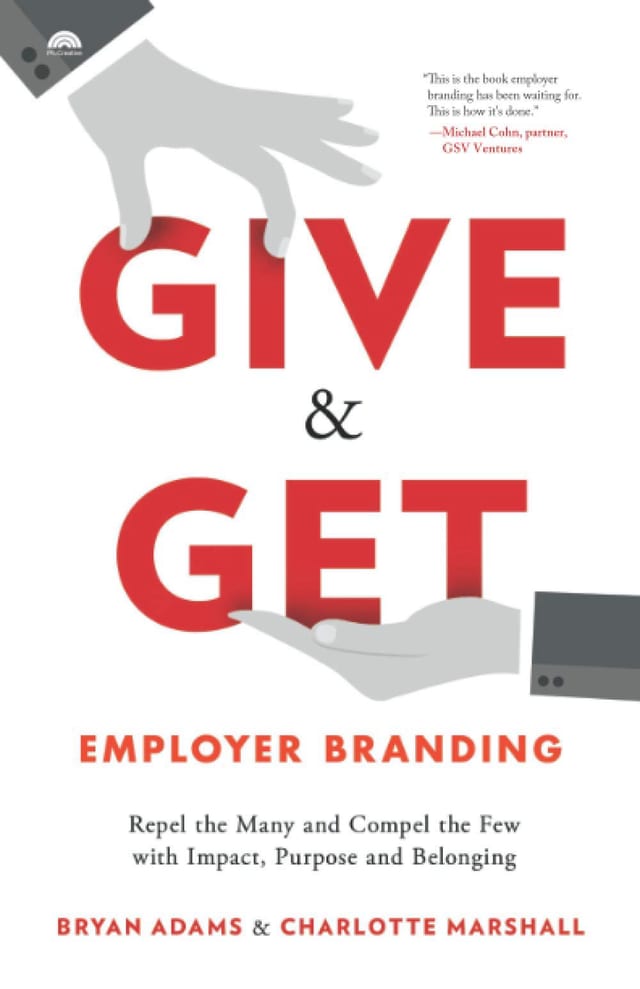
Give & Get Employer Branding
Repel the many and compel the few, with impact, purpose and belonging.
The book that put a name and a method to the repel-to-compel idea. It redefined the employee value proposition, moving it away from a sales pitch built on sizzle and toward the real cultural expectations of the organisation. It became a widely read book on employer branding.
Effective employer brands don't attract candidates. They repel them.
For years, employers were told to be as broadly attractive as possible: talk about the perks, the sunshine and the rainbows, and pull in as many applicants as you can. I never believed it. The strongest brands, in every category, work as a filter. They give people a reason to opt out as clearly as a reason to opt in. Do that with your employer brand and you stop competing on volume and start competing on fit, belief and belonging.
The smart filter
Turn your EVP into a filter, not a funnel. When it repels the wrong people, the right people trust it more.
Give and get
Name what the role asks of people before you name the reward. Honesty about the give makes the get believable.
Do I have what it takes
Answer the question every serious candidate is actually asking, and you attract commitment instead of clicks.
Impact, purpose, belonging
Build the brand on the three things people stay for, and you compete on meaning rather than on money.
Give & Get in five ideas
- The smart filter: an employer brand that filters as hard as it attracts.
- Give and get: name what the role asks of people as clearly as what it offers.
- Repel the many, compel the few: let the wrong people opt out so the right people believe you.
- Do I have what it takes: answer the question every serious candidate is really asking.
- Impact, purpose and belonging: build on the three things people stay for.
Endorsed across the talent industry.
This is the book employer branding has been waiting for. This is how it's done.
This approach moves the employer brand needle forward by at least a decade.
The smartest thinking on employer brand out there. A data-driven, persona-oriented method for candidate marketing.
This game-changing book gives you the framework to nail employer branding.
There isn't anyone who touches talent attraction, engagement or retention who shouldn't read this.
This book is important, progressive and brave.
You'll read this approach to employer branding and wonder why it's not been done this way before.
A strong, substantive argument for redefining how companies recruit employees. A clear, well-conceived and comprehensive plan.
Give & Get Employer Branding, answered.
What is Give & Get Employer Branding about?
Give & Get Employer Branding is a book on employer branding by Bryan Adams that reframes the employee value proposition as a smart filter. Instead of selling a role to everyone, it shows how to name what a job asks of people as clearly as what it offers, so the employer brand repels wrong-fit candidates and compels the right ones. The full subtitle is Repel the Many and Compel the Few with Impact, Purpose and Belonging.
What is the Give & Get framework?
The Give & Get framework pairs every strength or benefit with the real expectation or adversity attached to it. It turns the EVP into a mutual value exchange rather than a one-sided pitch, so candidates can see the whole deal before they commit.
How is Give & Get different from a traditional EVP?
A traditional EVP is a one-sided sales pitch of perks, whereas the Give & Get approach couples each benefit with what it genuinely takes to succeed. That honesty lets candidates self-select before they apply, so the brand competes on fit rather than volume.
Who is Give & Get Employer Branding for?
Give & Get Employer Branding is for employer-brand leads, talent-acquisition and HR teams, and leaders who want to attract committed, right-fit people. Kirkus Reviews called it a strong, substantive argument for redefining how companies recruit.
Where can I buy Give & Get Employer Branding?
Give & Get Employer Branding is available in paperback and ebook from Amazon, Apple Books, Barnes & Noble and Bookshop.org.
Read it, then bring it into the building.
The book gives you the method. A keynote or a working relationship gets your team using it.